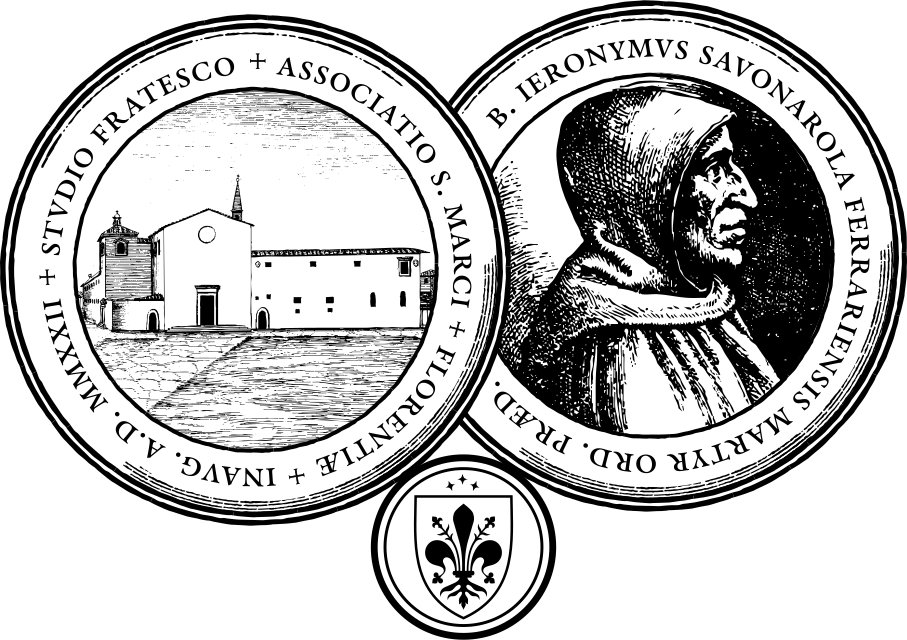


Excerpt from Sermon XXXVIII on Amos and Zechariah, preached on 25 March 1496, the Feast of the Annunciation.
What can we say about the praises of our Queen? I find it difficult to praise her sufficiently, for it seems impossible. “How can you not know how to praise her?” you might ask. “You have praised the Lord, who is far greater than she.” Even so, I have not praised Him adequately—indeed, not even to a thousandth part—indeed, in no way at all, beyond all comparison.
O Mary, your praise must be great, and we must praise you greatly, for your beauty has captured our hearts. O Mary, mother of God, you are the mother of the Creator; this is the highest praise, and one cannot praise you without also praising your Son.
O philosopher, how can it be that He who created the universe, who holds the world in His hand, who is everywhere, who is pure act, who can create and uncreate a thousand worlds at will, who is the first principle and the end of everything—how can it be that such a one is the son of a woman? And yet it is true.
O Mary, your beauty and humility pleased the eternal Father so much that He chose you alone among all women. You, Mary, knew yourself and considered God; and knowing Him, you said: “I am nothing, because He alone is who He is, and no creature is.” O Mary, you reckoned yourself as nothing, and therefore, because of your humility, you were exalted: Quia respexit humilitatem ancillae suae.¹ O Mary, when you were praying for human nature and saying, “O Father, when will you send your Son to redeem the world?”—in this your profound humility the Angel Gabriel was sent to you as a paranymph, who said to you: Ave, gratia plena,² telling you that you were full of every grace, that the Lord was with you more than with anyone else, and that you would be blessed above all women; and you were frightened, not out of fear of the Angel, but because you did not think yourself worthy of such a mystery; you were then all aflame with love, your heart full of joy.
Therefore, O Mary, we want you to be our queen, and to come to reign in Florence, for you are so humble and kind. Astitit regina a dextris tuis.³ O Lord, you are our King, and we desire this Queen, who is so enlightened; she will continuously pray for us because she is always in your presence. She is the advocate of sinners, and we commit many sins; she will be our advocate. Lord, you have been somewhat angry with us for a year now; yet she is always before you, she will placate you for us; she shows you the breast with which she nursed you. O Mary, intercede for us; your daughter Florence has sinned: it is true, we confess it, intercede for us, Mary, with the Lord, that He may forgive us; you stand at the right hand of your Son, you have an abundance of every grace, you have an abundance of riches: ah, pour them out upon us, Mary. In vestitu deaurato, circumamicta varietate:⁴ you have the golden garments of charity. Remember your daughter, remember that you have accepted her as your city; where is your charity, Mary? Ah, give her your grace, enlighten her, give her your milk. What grace will you give, Mary, to this people?
Now hear what she sends to tell you this morning. I will now speak to you in her person, and we will apply to you the following words. She says, “My people are not well disposed,” and thus she orders me to tell you to prepare yourselves well. Audi, filia, et vide;⁵ she says: “Hear, daughter.” The daughter is the city of Florence. So, be attentive and listen. First, we will speak to the citizens, then to the women, and finally to the children.
To the men: Audi, filia, ego quasi vitis fructificavi suavitatem odoris.⁶ “I,” she says, “am your mother, and you are my children. My son, strive to be like your mother; I am like a vine that produces the sweetness of fragrances. The vine bears grapes, which are distinct and separate in clusters and individual grapes; then they blend together to create one wine. I am the mother of love; I wish for you, citizens, to first unite in divine love, and then establish true peace—not just in words, but in deeds. Let many clusters and many grapes make one wine, let many souls become one soul, and let many hearts become one heart. I am,” says Mary, “the sweetness of all fragrances. The fragrances are the virtues, and the sweetness of all the virtues is humility. If you possess all the virtues but lack humility, you do not have the sweetness of fragrances.” Therefore, she says: “Embrace humility, as I have done. My foremost virtues were chastity and humility. And so, I am grieved that in your city there are so many wicked men indulging in that accursed vice. I cannot endure such filth and cannot come to that city, seeing so much impurity.”
This is what the Virgin says to you men. Now listen to what she says to you women.
Audi, filia, ego mater pulchrae dilectionis et timoris et agnitionis et sanctae spei.⁷ The Virgin says: “My daughter, if you want me to be your mother, do as I did—cover your head, be entirely modest.” Know that the Virgin dressed simply, in a humble garment; the Virgin is the mother of fair love, that is, not of worldly love, but of divine love. So, my daughter, do not have so many gowns and so many hairnets if you want to be a daughter of the Virgin Mary. You may say that it is customary to do so; I respond that you should not follow what others do if you want to be a daughter of the Virgin Mary. There are many who do not mind being called daughters of the devil, those who go about with those veils, loose locks, and immodest attire. Therefore, do not be ashamed of being called a daughter of the Virgin Mary, because she says: “If you are ashamed of being my daughter, I do not want you.” It should suffice you, then, to wear a simple white kerchief, arranged neatly and modestly; but there are some who desire thin veils costing two ducats each: no, no, these are not daughters of the Virgin Mary!
Come, then, my daughters, carry out your reform, so that each of you is a daughter of the Virgin Mary. Let none be ashamed of dressing simply. Christ was not ashamed to be naked on the cross for you; thus, you should not be ashamed to dress simply for the love of Christ. Furthermore, ensure that young girls do not converse too much at home with brothers or relatives; I do not say they should not talk or associate with them, but I mean in close quarters, because the serpent is ready to deceive. Women, do as I tell you; speak little with men, spend much time in prayer, and in the morning when you rise, make the sign of the cross: In nomine Patris et Filii et Spiritus Sancti, then begin to say the Creed and confess God first and His faith, then say your psalms and pray a little, asking God to order your life according to His will. This is the first duty of a good woman, as she rises in the morning. Then go and organize your house so that it is well-kept, and continue to pray silently in your mind, commending yourself to the Virgin Mary so that she may lead you to eternal life.
This is what the Virgin sends to tell the women. Now hear what she also says to you, my children.
Audi, filia: O soul of the child, hear. In me omnis spes vitae et veritatis, in me omnis spes vitae et virtutis.⁸ The Virgin says: “Be devout, my child, and leave the rest to me.” She also says: “Do you want to be devout? Do as I did, see how I preserved my virginity; guard yourself, my child, from the wicked, from these scoundrels, do not let yourself be deceived: be careful to whom you confess, because sometimes the wicked are found even among confessors, and seek good advice.” She further says: “I dressed simply; you too should dress simply, my child. Tell your father that you do not want a purse. Carry your handkerchief at your belt, as was the custom before. Go simply.” Learn, my children, to say that office of the Virgin according to the Roman Court (as I have told you before), and if you cannot say it all, learn it little by little. Commend yourselves to the Virgin, call her “my mamma,” for she is your mamma. Ask her to preserve you in chastity, and she will do so. Ensure that no wicked person is among your reforms; live well, and have hope that the Virgin Mary will deliver you from this pestilence and reserve you for the graces that are to come. You are the ones who will enjoy these graces more than others. These graces are all in her hands, and she says: “In me, in me they are.” You have by now seen so many signs that you ought to believe, and you have seen more of them this year than last. Audi igitur, filia, et vide et inclina aurem tuam et obliviscere populum tuum et domum patris tui:⁹ forget your people, that is, the past, that wicked past; and forget your father, if he is wicked, and let him go. And this is what the Virgin says to you, children.
Notes
“Because he hath regarded the humility of his handmaid” (Lk. 1:48).
“Hail, full of grace” (Lk. 1:28).
“The queen stood on thy right hand” (Ps. 44:10).
“In gilded clothing; surrounded with variety” (Ps. 44:10).
“Hearken, O daughter, and see, and incline thy ear: and forget thy people and thy father’s house” (Ps. 44:11).
“As the vine I have brought forth a pleasant odour” (Ecclus. 24:23).
“I am the mother of fair love, and of fear, and of knowledge, and of holy hope” (Ecclus. 24:24).
“In me is all grace of the way and of the truth, in me is all hope of life and of virtue” (Ecclus. 24:25).
Ps. 44:11.