

Miraculous Healing Wrought by the Lord upon Sister Caterina in 1540, on the 22nd of May.
[Translated from the visions of Saint Catherine de’ Ricci, originally preserved in the Monastery of San Vincenzo in Prato, and faithfully transcribed by Sister Tommasa Martelli between May and September of 1583 (manuscript 2363, Biblioteca Riccardiana, Florence).]
In the monastery of San Vincenzo in Prato, there was—and still is—a nun named Sister Caterina, daughter of Pierfrancesco de’ Ricci of Florence, who is now 18 years old. In the early part of the year 1538, in the month of March according to the Florentine calendar—thus two years and a few months had passed—she began to suffer continuous pain and torment in her body, accompanied by fever. According to the doctors, this was due to dropsy complicated by kidney stones, as was later clearly observed. And though every possible remedy had been tried, none proved effective. The doctor in Prato said: “Cease all treatments and baths being administered under my orders and those of Master Francesco Pagolo of Florence, for they only bring her further torment.” She remained bedridden for more than a year, and when she eventually tried to walk a little—solely to obey those who said that moving might help her affliction—she could only do so by leaning on crutches or a staff, moving little by little, afflicting herself and all who saw her.
Then, toward the end of March 1540, she began to expel stones—some as large as pine nuts in their shells or large chickpeas, and not only these, but also smaller stones, all with excruciating pain. The stones were nearly all of the same color: black and as hard as marble. And when she passed them, almost nothing but blood came out instead of water.
By the 21st or 22nd of April of that same year, the pains and constant sufferings in her body were so overwhelming they could not be described. She would say: “If I gave way to what I feel, I would often disturb the entire monastery by crying out in a loud voice.” And because she suffered from dropsy and a constant thirst for water, yet was unable to pass any fluid, her pain was all the greater, accompanied by shortness of breath. Unable to sleep or rest, day or night, the prioress ordered that each night a nun should stay awake with her, so that, being up all night about the house in anguish from her pains, she might bear them in better company.
Thus she continued for 30 days and 30 nights without any sleep, often saying: “Do you think I will lose my mind by never sleeping? It doesn’t seem possible to me that I can survive this.” Yet the nuns greatly comforted her, assuring her that she would not lose her senses, but that the Lord would help her—and in this, they placed all their hope.
When May 10 arrived, her father, Pier Francesco, hearing how much his daughter’s condition had worsened, wrote to the prioress urging her to make a vow for her to St. Vincent. He promised to spend two gold scudi to have a silver image made in the saint’s honor and asked the prioress to add a further vow: that the nuns would sing a Mass in honor of the said saint if she were healed within ten days.
However, many of the nuns say—and affirm—that at that time they had prayed to God, saying: “O Lord, if only this glory and this honor of the miracle were reserved for our three holy martyrs and for their coming feast!” Since the sanctity of St. Vincent was already known throughout the world, it seemed a common inspiration to ask God to reserve the miracle for the three holy martyrs. And so the ten days of the vow to St. Vincent passed, but she was not healed; in fact, she grew ever worse. Therefore, on May 21, a Friday—the day before the vigil of the three saints—a communal vow was made before Mass that, if she were delivered from such great sufferings, from the excessive swelling of her stomach, from the bloating that had long afflicted her body, and if she were also healed from the kidney stones within three days—that is, by May 23, which in that year was both the feast of the Most Holy Trinity and the day of the martyrs’ death, precious in the sight of God—they would, as soon as possible, sing in their honor three Masses and celebrate their feast for three consecutive years, if those present at the time were willing to do so.
After this second vow was made, as it seemed to the sick sister that she was growing ever worse, she asked me, Fra Timoteo—her paternal uncle and unworthy confessor of the monastery—to give her leave to remove from herself the relics of the saints that, with the approval of the prioress, some nuns had at that time had her put on. I, with all affection, discouraged her from doing so, exhorting her contrary to my usual custom, for I am not inclined to seek signs of miracles. I urged her to continue bearing the relics for as long as the term of the vow lasted. In the meantime, I told her to endure for the love of God, especially considering the hope she might have, for many of the nuns, in the three days preceding this vow, had been continually visiting the holy relics and praying for this poor, afflicted sister.
Then, on May 22, 1540, the vigil of the saints, a Saturday, around the seventh hour, as the suffering sister was overwhelmed by excruciating pain and despairing that the saints would heal her, she went to the little altar in her room, where some relics of those saints had been reverently placed on her account, with a lamp burning. Approaching them, she, with childish thoughtlessness and sudden impulse, removed the relic she wore around her neck and threw it onto the altar—yet with such little care that the said sister declared that, had the relic not been miraculously preserved, it could not have stayed in the position where it fell. She then resolved to remove the altar and place all the relics in the hallway of the infirmary, that is, outside her room, for she felt her condition worsening. In this feeble resolve, her head suddenly dropped onto her arm as she leaned on the altar, and she seemed to fall asleep.
And behold, three friars of the habit of St. Dominic, radiant in appearance, appeared to her. The one in the middle seemed to be surrounded by a cloud, and to him Sister Caterina said: “Who are you?” He replied: “Do you not know me?” She answered: “Father, no, I do not know you.” He then replied: “And to whom, then, do you ask for graces?” She responded: “I ask them of Fra Girolamo.” He said: “I am he.” Then he added: “But before I heal you, I want you to promise me two things. First, that you will strive, as much as you can, to practice the virtue of obedience; second, that you confess and receive Communion tomorrow morning.” This was, as mentioned above, the feast of the Most Holy Trinity and also his own feast and that of his companions, who with him had been burned on that same day in 1498 in the city of Florence. And after saying these words, he made the sign of the cross over her bloated stomach and over her body, then kissed—as it seemed to her—the right side of her face, where large and very red swellings had appeared. Then he said: “Rise and go, give thanks to God, and know that the tribulations will soon come, and our glory will be on earth.”
While he spoke, he kept his hand on her shoulder, and when Sister Caterina awoke, she found herself healed, her stomach and body completely relieved of swelling. She was filled with great terror and fear, which soon turned into immense joy, as one can well imagine.
And to recount it simply, as she herself said: when she looked at where her body and stomach had been, in the joy and gratitude of the gift and grace received, she expelled 32 stones—hard and black as touchstone. Some were as large as beans, others were cut with multiple facets. She also passed more than one measure of water along with the stones, all without any blood, which seemed truly miraculous; for while the stones she had expelled before, even though smaller, were nearly always mixed with blood and caused great pain, these larger stones came out in such quantity, yet without any pain or suffering. It should also be known that the amount of water and stones passed at that hour cannot be told, for she filled the vessel into which the 32 stones went, and these are still preserved. She passed a great deal more water with other stones, but they went to such a place that nothing more can be known of them. And furthermore, I say that for 16 continuous days before the miracle, she had been completely unable to pass any water.
The doctor, Maestro Francesco da Castiglione Aretino, who had examined her stomach and body three or four days earlier, upon seeing so many stones and such clear water without any blood, and the complete healing of her stomach and body from the swelling, found no trace of fever and said: “This is a miraculous work, something that nature cannot do,” repeating this several times in astonishment, as those present can attest. He also said that Sister Caterina, her face completely transformed, “is as one reborn”; and when he afterwards had to attend to the other sick sisters, he would declare again that this was miraculous, saying: “I am thinking of Sister Caterina.” And when the prioress considered what the doctor had said, she replied: “Maestro, although we have made a certain vow, please be content not to speak of this as a miracle,” without indicating even the slightest hint as to which saint or saints the vow had been made. The doctor replied: “Mother Prioress, it is wrong not to manifest the works of God.” But the prioress prudently acted as she did, with the counsel of the Reverend Father Prior of San Domenico in Prato, the confessor, and some of the elder mothers, not wishing at that time to speak of it, knowing it would not be heard as a testimony to God’s honor, but rather to the monastery’s credit, or as trafficking in vanity and partisanship. Yet the prioress and the other nuns desired that, having concealed so great a joy with such diligence, just as they were about to sing the three Masses in honor of the said saints, so too, according to the Lord’s will, the express miracle wrought by the great God through the intercession of the martyrs of the city of Florence might be revealed, and that not an hour be lost in making it known. To His Majesty alone be praise and glory from the entire world, and especially from His handmaids and the daughters of St. Dominic and of St. Vincent, for He delivered the entire monastery from inestimable sorrow and distress, for all the nuns carried great compassion for the afflicted sister.
End.
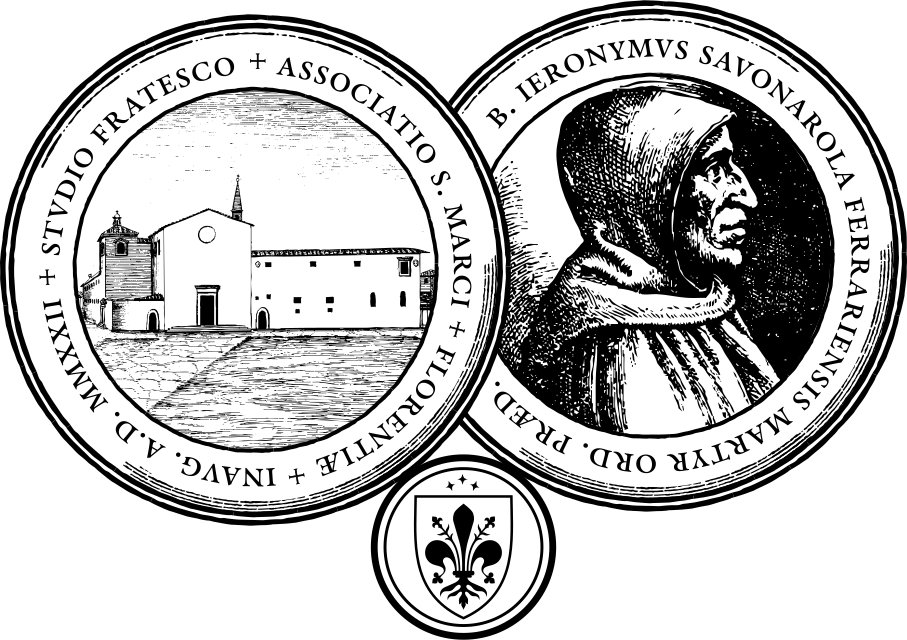
Tav. 11.08.1, Sanatione fatta sopra suor Caterina dal Signore. Manifesto, Studio Fratesco. Progetto grafico: Alexander Norton.
Manuscript 2363, Biblioteca Riccardiana, Florence; transcribed by Sister Tommasa Martelli, May–September 1583