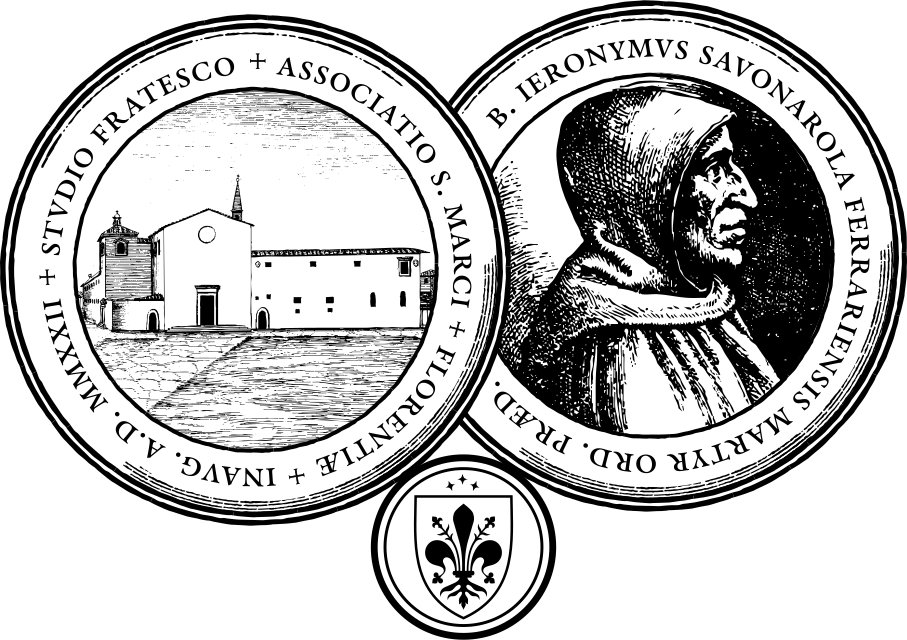


Girolamo Savonarola was born on September 21, 1452, in Ferrara, and from childhood was devoted to piety, solitude, and study. Detached from worldly pleasures, he quickly realized that beneath the splendor of the grand Renaissance lay the decay of a paganism striving to be reborn. He never once set foot in the Este Castle, where the nobility of his lineage could have easily granted him access, and where his rare and precocious knowledge could have earned him the most honorable positions.
Endowed with a most tender heart, he loved his family deeply: his pious sisters Beatrice and Chiara, and his brothers, one of whom would follow him into the cloister. He loved with sweet and reverent affection his father Niccolò and his mother Elena, who herself would outlive him to weep for his tragic death. He loved his dear Ferrara, where everything seemed to smile upon him; yet he was not content. The world seemed to him a cruel land, a barren shore, and he continually prayed to his God: “Make known to me, O Lord, the path I should walk, for to you I have lifted up my soul!”¹
At the age of 22, he heard an Augustinian preaching in Faenza, and certain words spoken by that friar penetrated his soul and were destined to remain with him forever. A year later, on a feast day, he left his family home and fled to the cloister of San Domenico in Bologna.
Before the tomb of the Holy Patriarch, under the guidance of holy teachers, he made giant strides on the path of virtue and knowledge. No austerity terrified him; the study of Sacred Scripture and the Fathers of the Church were his passion. He held a profound veneration for St. Thomas Aquinas and so deeply assimilated the doctrines of that Angelic Doctor that they became as his very flesh and blood.
And so he was trained in preaching and teaching, and gained powerful means to lead souls to Christ. Sent by his superiors, he exercised this dual mission in various cities of Lombardy. In his apostolic ministry, he received encouragement and holy counsel from the renowned Hermit of Calabria, St. Francis of Paola, who foretold the triumphs of his eloquence, the persecutions that would crown him as an Apostle, and the death that would seem a defeat in the eyes of the world but would instead be his ultimate victory.
Sent to Florence, he adopted the Flower of Tuscany as his second fatherland, a place where he would find devoted disciples and friends but also treacherous enemies. Even then, he foresaw that Florence would become the stage of a great struggle, one for which he prepared with willing heart and heroic love, ready for every sacrifice.
The Florence of the Medici family was the epicenter of a pagan Renaissance that pulled men away from Christ. The ancient faith in Florence had lost much of its primitive fervor, and with that fervor, she had also lost the freedom that once safeguarded her. Under Cosimo de’ Medici, freedom was still dreamed of but no longer truly existed; under Lorenzo the city realized it was lost but lacked the will to reclaim it.
Girolamo, seeking to bring the people back to Christ, drew the Florentines to hear him preach in San Marco and then in Santa Maria del Fiore with his powerful eloquence. They wept for their waywardness, burned vanities and instruments of corruption in the public squares, banished profane spectacles, and desired Christ to reign once again over their city.
The devotion to prayer, mortification, and penance reached an almost inconceivable intensity; so much so that internal and external enemies mocked Florence, saying it had turned into a cloister. Meanwhile, usury and licentiousness ceased. The poor, in their most desperate straits, found bread, and never before had the Buonomini of San Martino been so rich in treasures to distribute to the needy, who blushed to stretch out their hands.
The cloisters, where religious life flourished, became more like paradises. Eager young men, drawn to religious life, trained to become zealous preachers, pious writers, and inspired artists. Sixteenth-century Florence would find in the Convent of San Marco those who would sustain her, strengthen her, and preserve for her the ancient faith like an unshakable rock.
In a city where every virile spirit seemed weakened, a generation of strong souls arose, capable of frightening kings with a word, and who, when nothing else could be done, knew how to die as heroes. In this renewed Florence, Jesus Christ was proclaimed King, and the Virgin Mary was hailed as Queen. The name of Christ, King of Kings and Lord of Lords, was inscribed over the entrance of the Palazzo dei Signori.²
Nor were the holy desires of the apostolic and reforming Friar confined to Florence alone. He loved the Catholic Church with a fervent and unshakable devotion, carrying on his standard the words: “Long live Christ and the Roman Church.”
In his remarkable sermons and writings alike, he exalted the Church’s immortal glories, her divine origin, her indelible holiness, and foretold her triumphs. Yet, for her wayward children and unworthy ministers, he shed tears of profound sorrow and prayed to God to pour out His Spirit upon her once again in abundance. To those who grew ever more avid for the pleasures of the world, stubbornly turning their backs on Christ, he declared, on behalf of God, the swift and imminent coming of the sword of vengeance.
Truth begets hatred; yet to be hated by the licentious, by timid friends of truth, and by enemies of the public good is, for the Apostle of Christ, the highest honor, one he shares with his Divine Master. And if the Apostle, seeing that hatred has become implacable and that he will inevitably succumb to it, fails to recall the example of the Divine Victim and allows his zeal to falter, he betrays his mission.
Fra Girolamo, as the hatred of the wicked raged ever more fiercely, wrote to his mother on December 5, 1495: “I wish your faith to be so great that you could see your son die and be martyred without shedding a tear, as did that most holy Hebrew woman who witnessed her seven saintly sons killed and tortured before her eyes and yet encouraged them to face death!”³
With this certainty, Fra Girolamo continued to draw new impetus from contradictions and obstacles to secure the good of the Church and his beloved Florence at any cost, repeating the words of St. Paul, “For to me, life is Christ, and death is gain.”⁴
But his enemies grew ever more relentless, making false accusations before the Supreme Pontiff, who, misled, silenced the Friar. Fra Girolamo fell silent, praying and asking others to pray until his innocence was acknowledged. Once his permission to preach was restored, he was once again accused with even greater malice of crimes so absurd that they provoked an excommunication—one that the Pontiff himself regretted before it was even published.
Fra Girolamo withdrew to his convent, employing every means permitted by Church law to defend himself in this difficult case. Yet his enemies had a powerful weapon in hand, and they now sought his death at any cost, despite his innocence being ultimately recognized by all good people and even by the Pope himself. His only “fault” was speaking the truth without fear, denouncing vice, loving virtue, and zealously defending the honor of the Church.
Besieged in the Convent of San Marco, he was taken to Palazzo Vecchio, where a government hostile to the Friar and his followers had formed under the machinations of the Republic’s enemies. Since there was no legitimate evidence, his trial was falsified. Condemned to a cruel death for no reason other than the hatred that vice bears for virtue, on May 23, 1498, Fra Girolamo was led to the scaffold in the Piazza della Signoria.
Ascending the steps of the gallows, he recited the Credo with the same fervor he had shown in the prison of the Palazzo, where he had adored the Holy Eucharist before receiving it as viaticum, and with the same humility with which he had accepted the plenary indulgence and the apostolic blessing from the representative of the Pontiff. He was hanged between his two companions; his body was then burned, and the ashes scattered into the Arno River to prevent the faithful from venerating it.
Efforts were made to erase his memory. The friars whom he had lovingly gathered in San Marco were condemned to harsh exile. Yet, among the people, the infamy of his trial became known. It was revealed that the Roman Commissioner had found no reason to sentence him to death, that even the notary who falsified the trial confessed that Fra Girolamo was a Saint of God and that fabrications were necessary to secure his execution. The three Benedictine confessors assigned to Fra Girolamo and his companions declared them to be holy religious, and their patience under torment drew words of praise even from their executioners.
The original devotion to him reawakened. Pious women were seen praying and laying flowers at the site of his martyrdom. His veneration lived on in Florentine families, two of which would produce for Florence flowers of sanctity: Philip Neri and Catherine de’ Ricci. Catherine, praying before the relic of Fra Girolamo’s finger, preserved from the flames, obtained many graces through his intercession, calling him a “most victorious martyr.” Philip Neri, who owned and prayed before an image of Fra Girolamo adorned with a halo, continued the salutary work of reform in Rome, begun by the Ferrarese Friar in Florence. In an ecstatic vision before the Blessed Sacrament, Philip rejoiced as God revealed to him that Fra Girolamo’s teachings had been declared firm and unshaken by the Apostolic See.
With them, an illustrious company of saints held Fra Girolamo dear and his name in veneration. Blessed Colomba of Rieti saw his soul ascending to heaven. Blessed Catherine Mattei of Racconigi saw him as apostle, prophet, and martyr adorned with the triple crown. Blessed Maria Bartolomea Bagnesi obtained miracles through contact with his relics. The great Bishop of Rochester, St. John Fisher, who would fall victim to the hatred of heretics, saw in Fra Girolamo a staunch defender of the Catholic faith and one of the strongest opponents of Luther’s heresies. Several Roman Pontiffs have venerated him. Julius II commissioned Raphael to depict him in The Disputation of the Sacrament in the Vatican. He even remarked to the Dominicans of Viterbo, “I will canonize him.”
As in his life, so too would he find fervent friends and indomitable enemies after his death. There would come those who would fail to understand the nature of his zeal, who would judge him unfairly, or outside the context of his time and the men among whom he lived. There would also be misguided admirers who would raise his name on their banner and praise in him, contrary to historical truth, things that, if true, would be worthy of great reproach.
Yet no holy person has ever opposed him, and among the good and the just, true estimators of virtue, he will always have admirers and followers.
Fr. Lodovico Ferretti, O.P.
Periodico Quarto Centenario della Morte di Fra Girolamo Savonarola (No. 1, January 1898, Florence).
Notes
“Make the way known to me, wherein I should walk: for I have lifted up my soul to thee” (Ps. 142:8).
“King of kings, and Lord of lords” (Apoc. 19:16).
Cf. 2 Mac. 7:20–23.
“For to me, to live is Christ; and to die is gain” (Phil. 1:21).
Periodico Quarto Centenario della Morte di Fra Girolamo Savonarola, No. 1, January 1898, Florence